CALL MANAGEMENT • Configure the call once, the nine stages then run themselves.
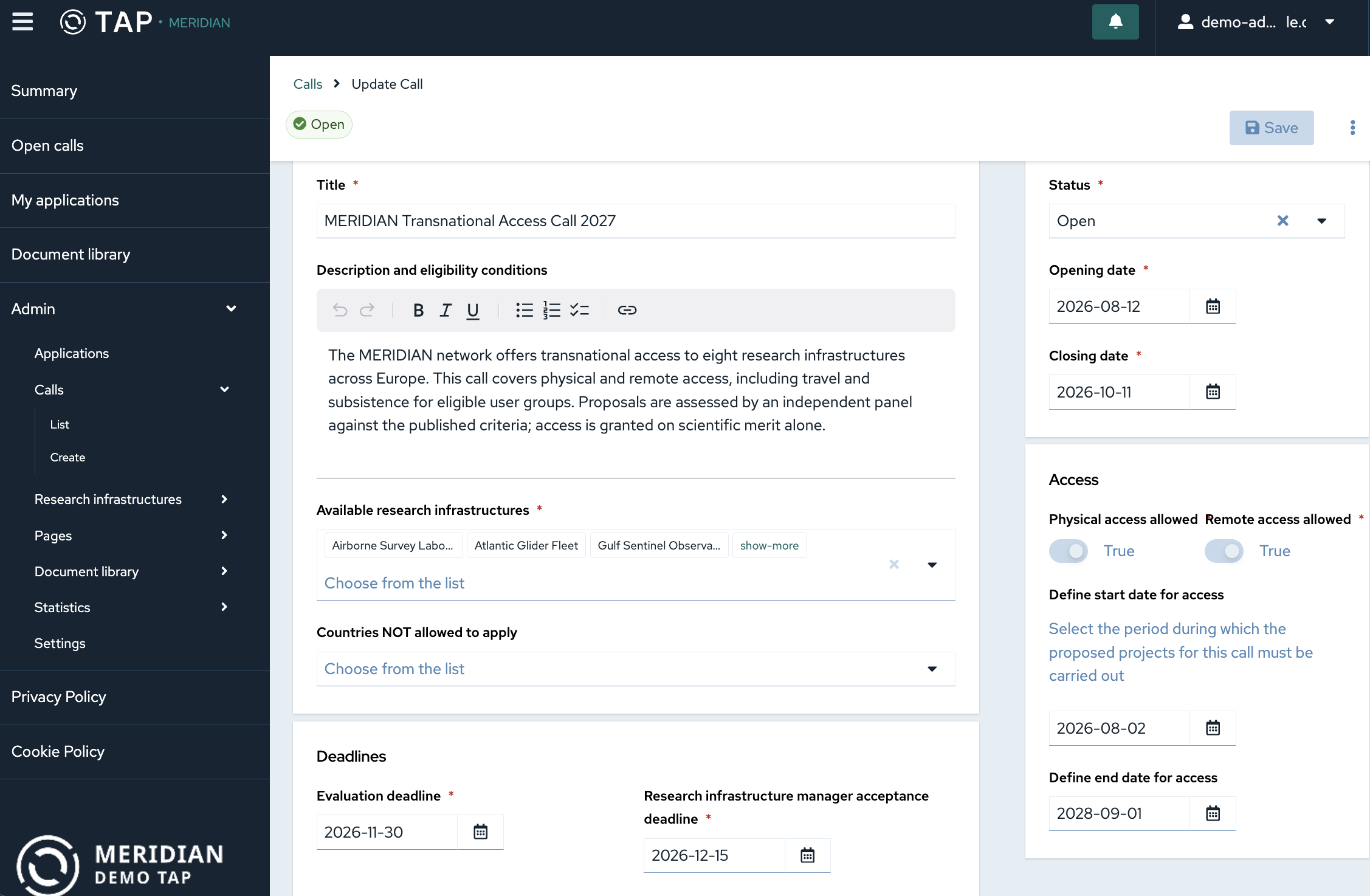
Eligibility rules, access modes, a deadline per phase. Around fifty settings you change yourself, without raising a ticket; the form structure and the evaluation criteria are set up with you, and changed on request within a few working days. The call opens and closes to the second in the time zone you set, and nothing arrives afterwards by another channel. Nine stages then carry a proposal from submission to reporting: at each one it advances or exits, and every status change is timestamped as it happens rather than reconstructed at the end.
0.5% of submitted proposals are ruled not eligible. Because eligibility is checked while the applicant is writing, not after they submit.
EVALUATION & GRANT • The panel closes on time, and the letters write themselves
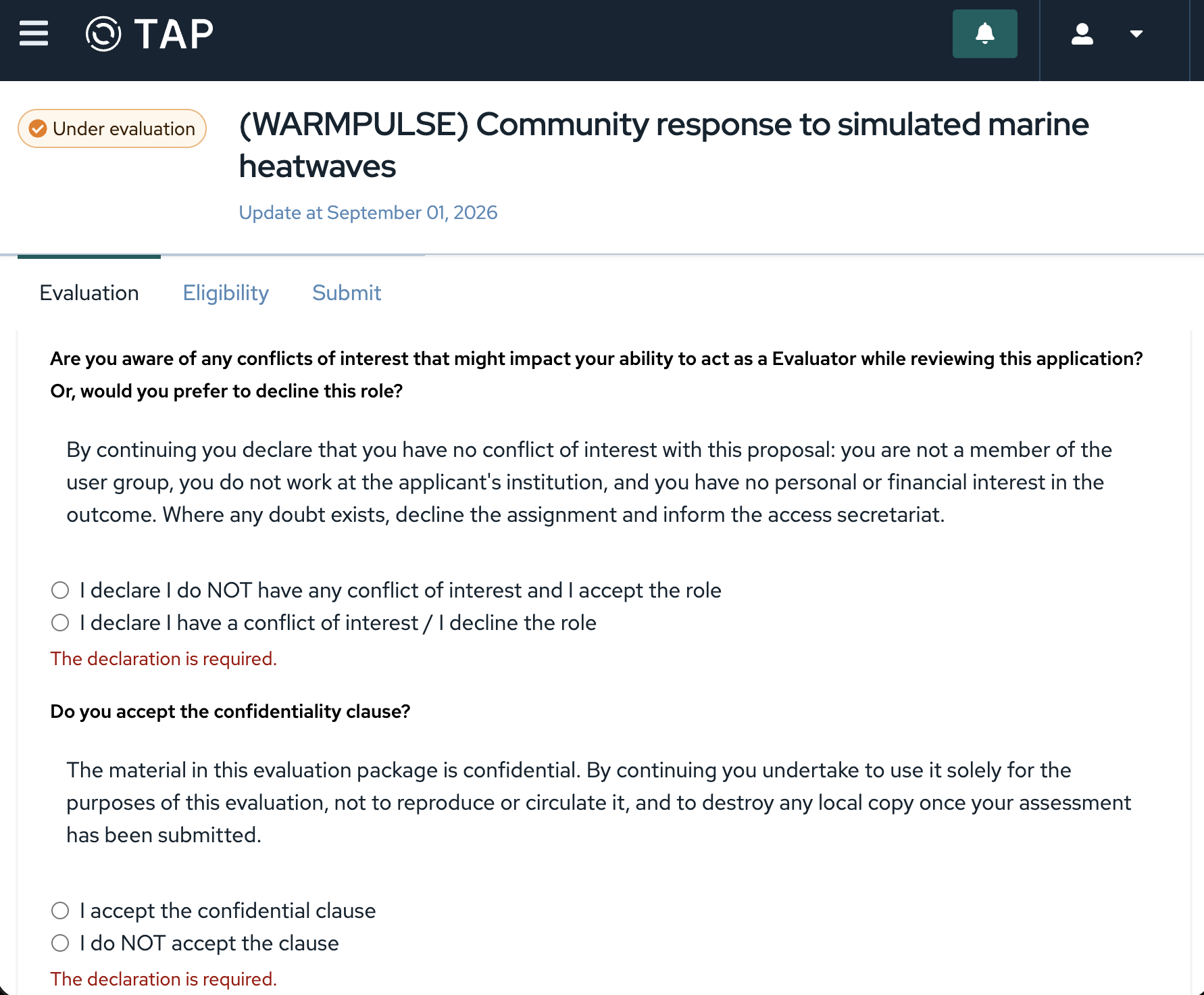
Reviewers are invited for each proposal and work from a personal queue rather than a thread, scoring each weighted criterion with a written justification. Confidentiality is signed and conflicts declared before the download exists. Access control applies when the file is built, not only when a screen is drawn. A Evaluation Reviewer reads every evaluation, so divergent scores surface before the panel meets rather than during it.
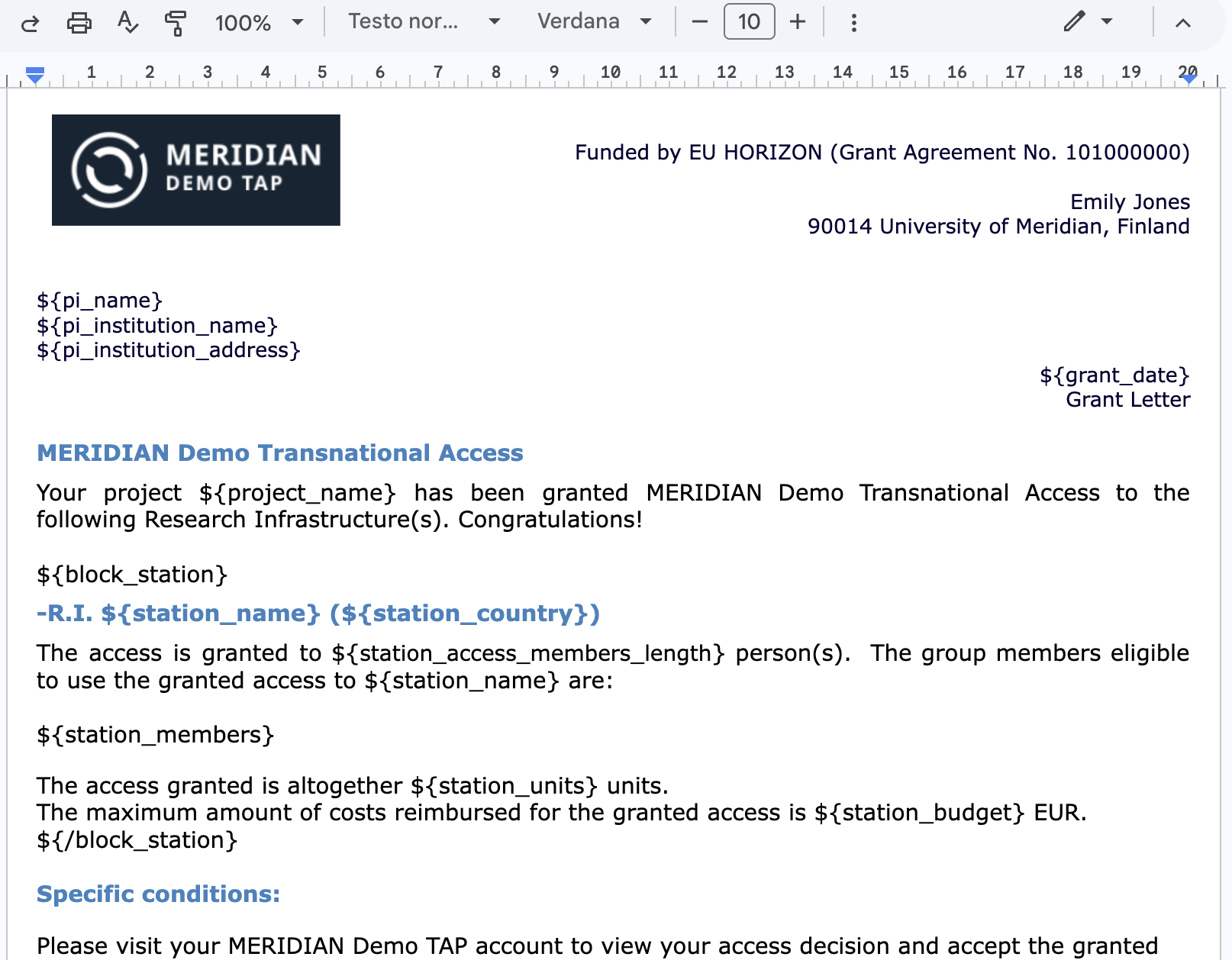
When the panel has decided, nobody assembles the letters by hand: one Word template on your own letterhead, filled in with the group leader, the institution, and a block per accepting infrastructure. Units, budget, the members cleared to travel. Signature, countersignature and each facility’s prerequisites are separate states, so you can see which files are genuinely clear to travel.
218 experts approached · 59 accepted · 52 delivered on time. One network’s first call, which is the whole argument for the invitation and reminder machinery around them.
RESEARCH INFRASTRUCTURES • A research vessel is not a station with a hull
Eight infrastructure types. Station, vessel, airborne platform, fixed and mobile marine platforms, observatory, experimental facility, core repository. Each with its own data model, so a vessel describes its area of operation and a repository its holdings. Each also defines its access modes (in person, remote or both) and what one unit of access means for it. Availability windows are enforced rather than published: a February request to a station that opens in June never reaches the manager who would have had to refuse it.
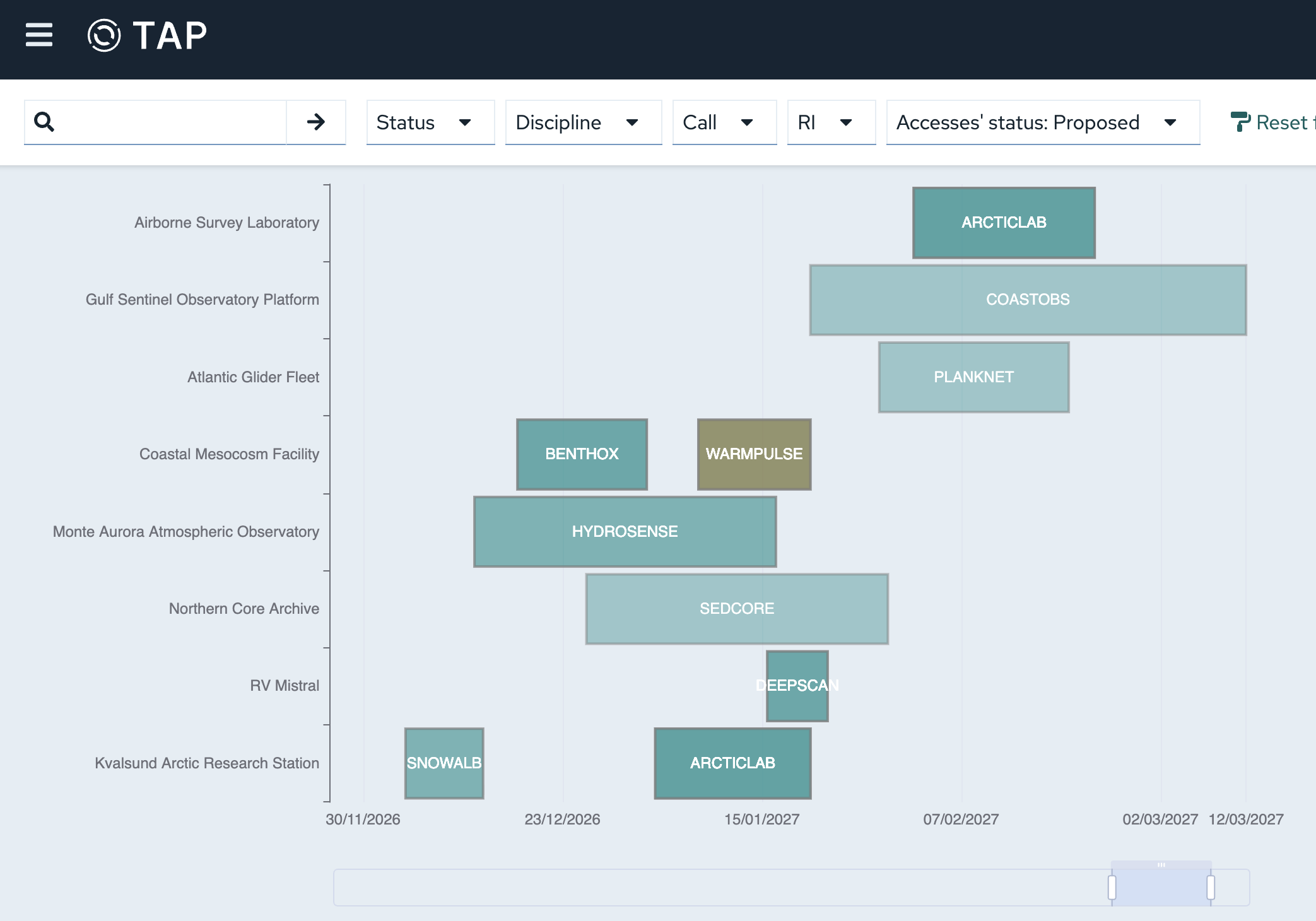
One timeline per facility. Double bookings stopped before they happen, and the originally planned date still visible when a plan slips.
REPORTING • The access section of your periodic report is an export, not a project
It starts per project. The scientific report goes to the Evaluation Reviewer; access delivered, units used and costs go to the infrastructure manager; the data management plan is a third strand rather than an attachment, reviewed by the network’s own data manager with its own report and its own statistics screen.
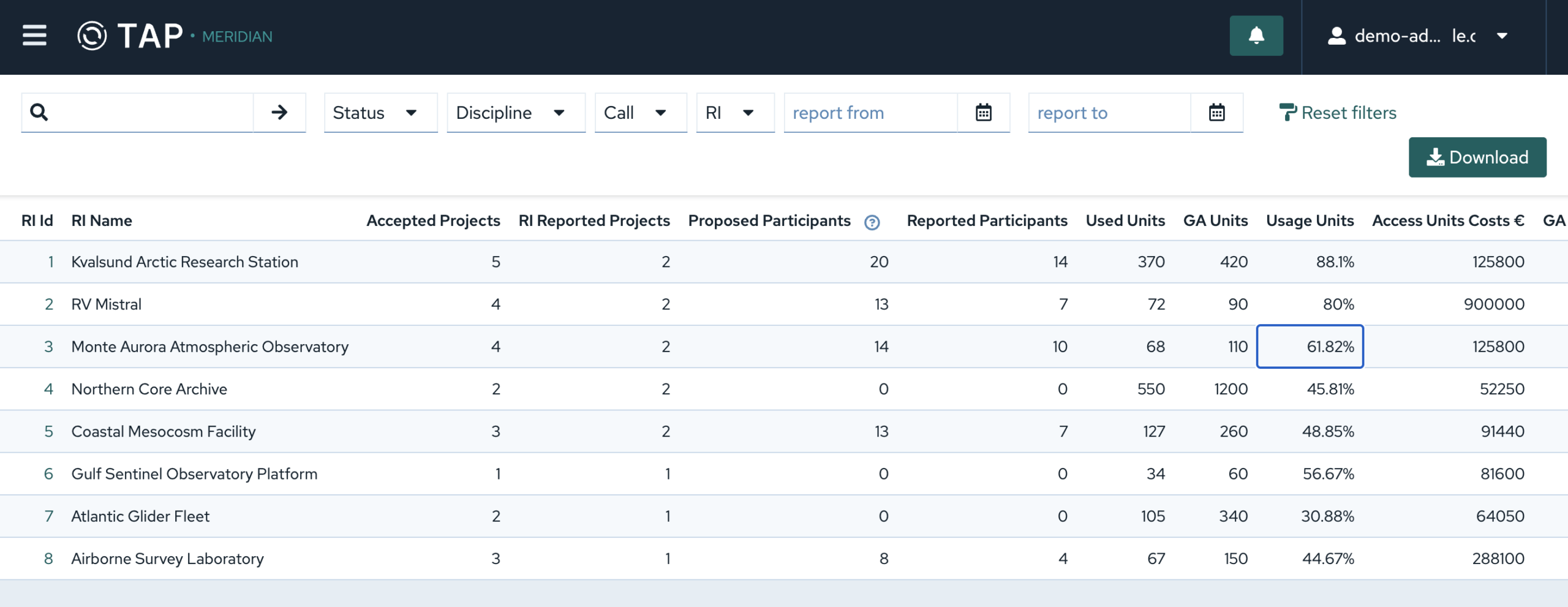
Those reports are what the export is built from. Ten report types and thirteen screens export to Excel, each under the same permissions as the rest of the platform: a facility manager exports their own infrastructures, without a filter to remember and without seeing anyone else’s. Units stay separated end to end (requested, recommended and reported, per access mode, per infrastructure) so nothing ever has to be re-derived.
Two indicators run per infrastructure rather than per call: days from recommendation to decision, and days from the visit to the reimbursement reaching the user. The second is the figure a network usually discovers through complaints; here it sits next to the consortium average, per facility. Your Grant Agreement allocation against units actually used is maintained continuously, so an infrastructure well below it halfway through a programme can still be given more projects.
Elapsed times are quoted as medians from the platform, not as estimates. Every status change was timestamped when it happened, so nobody reconstructs a date from an inbox at report time.
AI • Where it is, and where it deliberately is not
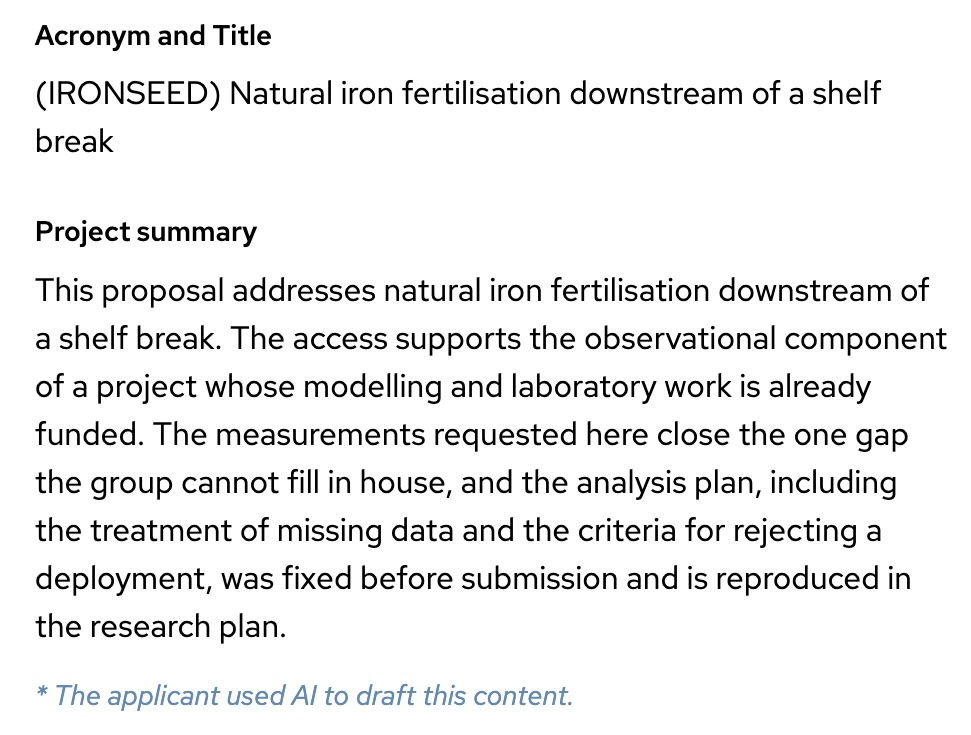
An applicant can turn a research plan into a first draft of the form. Once per proposal, with the use recorded and visible in your exports. Candidate infrastructures and candidate reviewers are coming soon, both as suggestions made to a person who decides.
No score, ranking or recommendation is machine-generated, and none is planned. The models run on the same European infrastructure as your instance: nothing is sent to an external AI service.
TECHNICAL SUPPORT • Answered within one working day, and staffed when your call closes
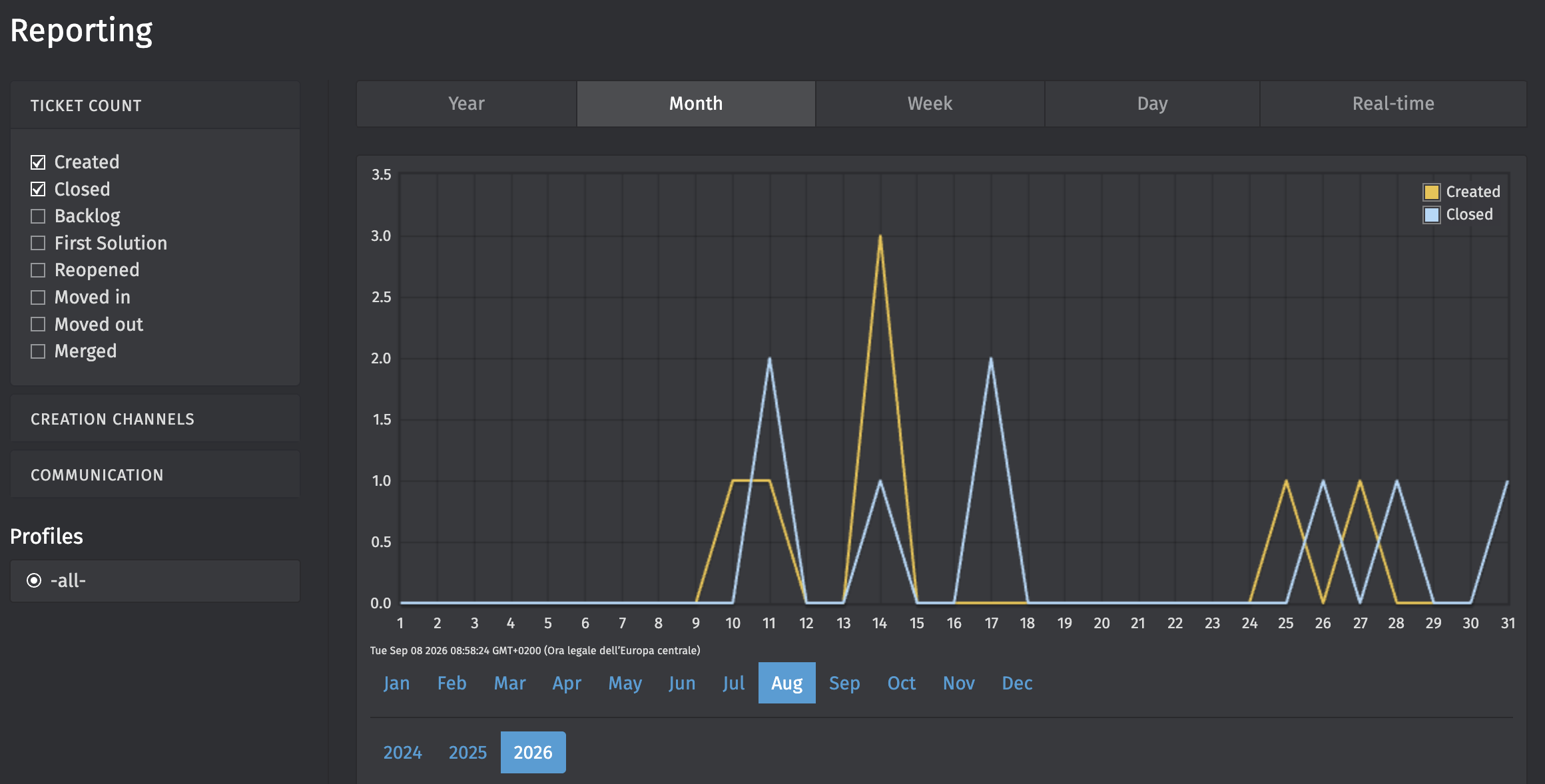
By email or in the ticket system’s own web interface. Email lands in the same queue, so nothing depends on one person’s inbox. Open to your secretariat, your facility managers and your applicants alike: during submission week, the questions do not all land on your secretariat. Call windows are agreed in advance and staffed: inside one, a defect blocking submission or a decision tied to a deadline is an incident, not a ticket.
In four Horizon access programmes, no call has yet been delayed by a platform failure.
MENTORSHIP & OUTREACH • Two services around the platform, And neither of them decides anything
The platform handles access; but you manage it.
Mentorship puts a named adviser who has run access programmes since 2011 alongside a secretariat that exists but has no precedent to draw on: your first call, your first panel, your first periodic report.
Outreach gets the call in front of the right applicants. The criteria, the panel and every funding decision stay yours.
Under-subscription is the finding a funder reads worst, a call that reaches the same twenty groups every round returns a ranking with no depth in it.
DATA PROTECTION AND SOVEREIGNTY • You are the controller, The instance is yours alone
You remain the data controller throughout, under a data processing agreement drawn up and signed when the work starts rather than retrofitted later. Your instance lives in Europe, dedicated and isolated, with its own identity realm: one network’s data is never co-tenanted with another’s. That also means one network’s configuration change cannot affect another’s live call.
Login connects to your own institutional identity provider rather than to ours. We implement against your federation instead of asking you to adopt one, so OpenID Connect, OAuth2, SAML and LDAP are configuration rather than development. Eight roles then carry permissions set per field rather than per screen: a panel viewer sees a proposal without seeing its evaluations.
Data is kept for your grant audit period and deleted on request, and you decide when that point is reached. Reports and statistics export to Excel as a standing feature, so getting your own figures out is never a request you have to make. Two things worth knowing in advance rather than at the end: a complete dump of every record with a documented schema is defined work at exit, not a packaged function today; and the interface targets WCAG 2.2 Level AA at component level, with no formal conformance statement at application level yet.
Confidentiality declarations are signed per person per proposal, conflicts declared with a timestamp. When an audit asks, the answer is a record rather than a recollection.